
The information relates to the following two sections of the Deployment of nbn® Conduit and Pit network guideline (NBN-TE-CTO-194):
- 4.8.5 Super Lot Pit and Conduit internal reticulation.
- 4.8.6 Barrier Kerb.
What is a Horizontal MDU?
Horizontal Multi Dwelling Units (Horizontal MDU) in a new development refer to a group of units, townhouses or factories built within the boundary of a large piece of land/Super Lot e.g. gated communities, retirement villages. This could also refer to an existing estate/suburb where a Horizontal MDU is built as a result of a knockdown/rebuild (also referred to as infill areas).
A Super Lot is a parcel of land with no actual dwellings built on it, but rather just land being prepared with pit and pipe to be set aside for future development.
Size of Horizontal MDU developments
To assist developers and their external design consultancies, and to ensure there is no over engineering when working out the amount of pit and pipe required for each premises, nbn deliberately separates the size of Horizontal MDU into two distinct groups – these are:
Horizontal MDU: 4 to 24 premises
Smaller Horizontal MDU require a minimum P50 conduit as the main conduit reticulating through the development, this includes P5 and P2 pits as the minimum requirement. The internal pit and pipe reticulation would be similar to either single or dual sided installation.
Horizontal MDU: 25 or more premises
Larger Horizontal MDU would require a minimum P100 conduit as the main conduit reticulating through the development. Depending on the size of the Horizontal MDU, this may include P8, P5 and P2 pits. P9 pit/s may also be required to support FDH/s. The internal Pit and Pipe reticulation would be similar to either single or dual sided installation.
Things to consider before design and install
- A Barrier Kerb can be used in either scenario to protect pits inside the development area from vehicular traffic. Note a Barrier Kerb is not to be used in the road reserve (nature strip) outside of the development.
- The preference for pit installation is within common areas, landscaped areas, and internal footpaths.
- Developers are responsible for providing connectivity to each premises - both internal and street facing.
- Generally, the street facing premises could be fed via the internal pit and pipe providing Deployment of nbn Conduit and Pit network guidelines (NBN-TE-CTO-194) are met. If a Horizontal MDU contains a percentage of street frontage premises that have limited or no existing pit and pipe in the adjacent road reserve outside of the development (see Figure 1), then the developer must ensure the internal pit and pipe continues out into the road reserve. In these situations, the development boundary will encompass the external pit and pipe as part of the overall development pit and pipe design.
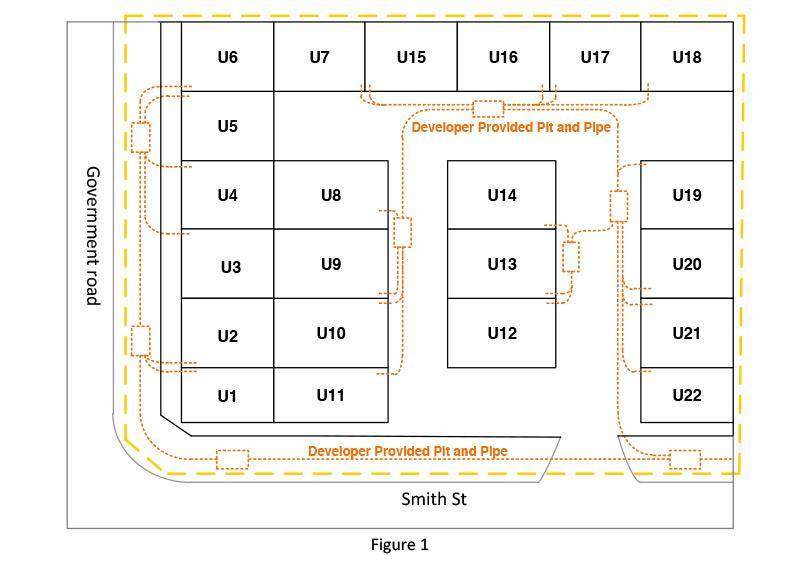
Figure 1: Horizontal MDU with street frontage and internal premises containing developer installed pit and pipe.
- All residential premises must have an individual nominal P20 conduit installed from a pit attached to each premises.
- All factories or light commercial premises must have a minimum P50 conduit installed from a pit attached to each premises.
- Where there is limited existing nbn pit and pipe available in the road reserve (outside of the development boundary) to service the street fronting premises, additional pits and service drop conduits will be installed by nbn over the existing network and funded by the developer (see Figure 2, 3, 4). The developer must install the lead-in conduit from the street facing premises to the development boundary to complete connectivity.
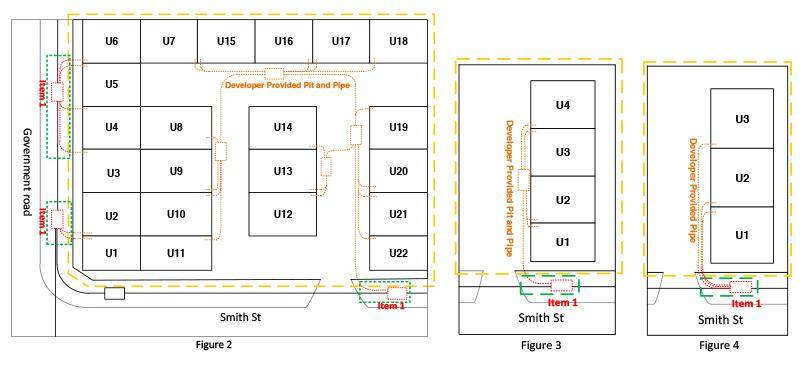
Figure 2, Figure 3, Figure 4: For Horizontal MDU developments reflecting internal pit and pipe and street facing premises require the installation of additional pit/s and or service drop conduits (Item 1); over existing network conduits. This will be installed by nbn and funded by the developer to ensure connectivity to all premises.
Health and safety
Health and safety must be taken into consideration when deciding the pit locations within an Horizontal MDU development. Pits are not to be installed in any area that is open to traffic. These include:
- Roadways
- Driveways
- Gateways
- Vehicular access ways
- Turning circles
- Car parks including wash bays
- Bin storage areas
Frequently asked questions
No. Pits are not to be located directly in any driveway or roadway.
Where garden bed/s are not available, pits can be protected by barrier kerb type B1 or similar as reflected in Deployment of nbn Conduit and Pit network guideline (NBN-TE-CTO-194) Section: 4.8.6 Barrier Kerb.
No. Please refer to Deployment of nbn Conduit and Pit network guideline (NBN-TE-CTO-194) Section: 4.8.6 Barrier Kerb for examples of Barrier Kerbs that can be used.
To find out the costs involved in additional pits and service drop conduits contact codevelopment@nbnco.com.au
Phone: 1800 687 626
This guide should be read in conjunction with the latest release of ‘Deployment of nbn™ conduit and pit network’ document (NBN-TE-CTO-194) found on the Design guidelines page. If you have any further questions please contact your Deployment Specialist by emailing developerliaison@nbnco.com.au. nbn has prepared this document as a guideline to the installation of pit and conduit infrastructure in new developments (also known as Greenfields developments). You should also refer to all relevant legislation, including the requirements in relation to fibre-ready facilities contained in the Telecommunications Act 1997. nbn has no control over new laws. nbn cannot and does not make any promises about the contents of new laws and how they will affect you. nbn has used its best efforts to prepare this document to provide you with an indication as to how installation of pit and conduit infrastructure may occur. If new laws are passed, substantial changes may be required to the guidelines and technical details set out in the document.
nbn confidential information. This document is provided for information purposes only. The recipient must not use this document other than with the consent of nbn and must make their own inquiries as to the currency, accuracy and completeness of this document and the information contained in it. The contents of this document should not be relied upon as representing nbn’s final position on the subject matter of this document, except where stated otherwise. Any views expressed by nbn in this document may change as a consequence of nbn finalising formal technical specifications, or legislative and regulatory developments. This document is intended as an informational guide only. nbn does not warrant that the processes and information outlined in this document comply with all (or any) applicable laws. The recipient must exercise its own judgment as to how best to perform the activities described in this document in a safe way, and so as to meet the requirements of all applicable laws. This document is accurate as at 24th September 2015.